
Automotive Industry
Laser Solutions for Automotive Manufacturing | HGLaser


 September 11, 2026
 748 Viewed
Introduction
In 2017, the V100 GPU had a power consumption of 300 W. By 2024, the B20 had reached 1,200 W, while industry forecasts suggest that the VR300 could reach 3,600 W by 2027. As the cooling demand of a single rack exceeds 100 kW, the 40–50 kW thermal ceiling of conventional air cooling is becoming a critical bottleneck for AI computing expansion. Meanwhile, increasingly stringent global PUE requirements are accelerating the shift from liquid cooling as an “optional upgrade” to essential infrastructure for AI data centers.
The safety, service life, and cost of a liquid cooling system ultimately depend on the welding quality of its core components, including cold plates, manifolds, and pipe fittings.
In this issue, we examine the underlying drivers of the liquid cooling boom from three dimensions — computing power, policy, and market demand — and compare the key differences among air cooling, cold plate liquid cooling, and immersion cooling. This provides the industry background for our upcoming deep dive into laser welding technologies for liquid cooling applications.
1. Exploding Computing Power: Air Cooling Is Hitting Its Physical Limits
1.1 Rapid Growth in Chip Power Consumption
The rise of AI foundation models and high-performance computing clusters is driving a rapid increase in GPU density, with configurations scaling from 72 GPUs to 144 GPUs per system.
As the thermal density of a single rack exceeds 100 kW, and can surpass 200 kW in some immersion cooling scenarios, conventional air cooling is approaching its practical limits.
Airflow systems also occupy significant data center space. Under high loads, insufficient heat dissipation can cause chips to throttle, resulting in noticeable computing performance losses.
In China, new AI data centers are subject to increasingly stringent PUE requirements, with PUE targets below 1.15 for certain new facilities and a maximum of 1.25 for designated hub nodes. Europe is targeting climate-neutral data centers by 2030, while the United States has introduced mandatory energy-use disclosure requirements.
Typical air-cooled data centers have a PUE of around 1.4–1.6, while cold plate liquid cooling can reduce PUE to approximately 1.05–1.25.
For a 10 MW data center, reducing PUE from 1.5 to 1.2 could save approximately RMB 18.4 million in annual electricity costs.
Operating energy consumption: Liquid cooling can reduce cooling-related energy consumption by approximately 20% compared with air cooling.
Equipment service life: Server service life can potentially be extended by 2–3 times.
Return on investment: Liquid cooling retrofits can achieve a payback period of approximately 2–3 years.
The global liquid cooling system market is projected to grow at a CAGR of 19.8% from 2025 to 2031, with the market expected to exceed USD 100 billion by 2031.
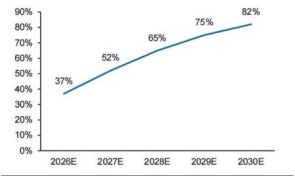
China's liquid cooling penetration rate is expected to reach 37% in 2026 and rise to 82% by 2030.
Cold plate liquid cooling is expected to maintain a dominant position, accounting for approximately 80%–90% of the market in the long term, thanks to its compatibility with existing maintenance practices and relatively low retrofit costs.
Immersion cooling is primarily targeted at specialized, ultra-high-density computing applications.
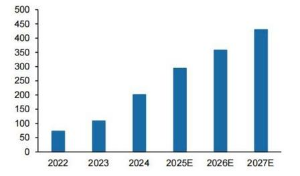
China's liquid-cooled server market is expected to reach RMB 29.4 billion in 2025 and exceed RMB 40 billion by 2027.
New AI computing infrastructure projects are increasingly adopting liquid cooling architectures as standard configurations.
| Comparison | Air Cooling | Cold Plate Liquid Cooling | Immersion Cooling |
|---|---|---|---|
| Typical PUE | 1.4 - 1.6 | 1.05 - 1.25 | 1.03 - 1.10 |
| Typical Cooling Capacity per Rack | 40 - 50 kW | 100 kW+ | 200 kW+ |
| Reliability | Higher temperatures and potential thermal throttling; uneven heat dissipation | Precise temperature control with improved thermal management | Highly stable temperature control |
| Space Efficiency | Large airflow ducts occupy significant space | No redundant air ducts; enables higher deployment density | Entire systems are immersed; highest density |
| Initial Investment | Low | Medium | High |
| Operating Energy Consumption | High | Reduced by approximately 20% | Lowest |
| Typical Applications | Retrofitting existing data centers | New AI data centers; mainstream solution | HPC and high-end GPU clusters |
Cold plate liquid cooling is currently the most practical solution, offering a balance between retrofit costs, existing maintenance practices, thermal performance, and supply-chain maturity. It has therefore become a standardized solution for a large proportion of AI computing infrastructure.
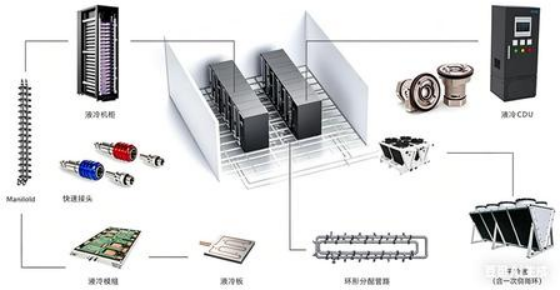
A typical liquid cooling system consists of:
Primary cooling loop: Cooling tower + CDU (Coolant Distribution Unit)
→ Secondary loop: Manifold
→ UQD (Quick Disconnect Coupling)
→ Cold plate attached to the CPU/GPU
The coolant circulates through the system to continuously remove heat generated by the chips.
Cold Plates
Copper or aluminum cold plates feature thin-wall microchannel structures. Any leakage in a weld can potentially cause a major system failure and therefore requires 100% leak-tightness.
Manifolds
Manifolds involve multiple branch connections and saddle-shaped weld joints. Uneven flow distribution or inconsistent weld penetration can lead to temperature differences across the rack.
UQD Quick Disconnect Couplings
UQDs may involve dissimilar-metal welding between copper and stainless steel. Under long-term thermal cycling, the welded joints must demonstrate excellent fatigue resistance and corrosion resistance.
Common Industry Challenges
Vacuum brazing involves high energy consumption and may leave brazing filler residues that can corrode internal flow channels.
Friction stir welding is suitable for a relatively limited range of structures.
Conventional welding can result in significant deformation and inconsistent quality in mass production.
As a result, laser welding for hermetic sealing is emerging as a next-generation standardized manufacturing process for liquid cooling components.
The rapid growth of AI computing power is driving the liquid cooling industry into a period of accelerated expansion, with cold plate liquid cooling emerging as the mainstream solution.
The reliability and cost challenges of liquid cooling systems are increasingly concentrated in the precision sealing and welding processes used to manufacture their core components.
In HGLaser Tech Academy 02, we will take a closer look at three major welding technologies used in liquid cooling manufacturing:
Laser Welding vs. Vacuum Brazing vs. Friction Stir Welding
We will compare them across equipment investment, cost per part, yield, and mass-production suitability to explore which welding technology is best suited for different liquid cooling applications.
 share
share


