
Automotive Industry
Laser Solutions for Automotive Manufacturing | HGLaser


 August 26, 2026
 800 Viewed
What happens when AI is combined with additive manufacturing, just as bread plus sausage gives birth to hot dogs?
Watch the video below to explore brand new solutions for the industrial scale mass production of AI driven design.
Today’s industrial manufacturing has shifted from “process adapted design” to “design driven process”. Powered by robust computing and simulation capabilities, AI topology optimization can generate lightweight, highly integrated complex topological structures such as hollow lattices, enclosed micro channels and integrated special shaped components. It has become a key development trend for aerospace, automotive and 3C electronic product upgrades.
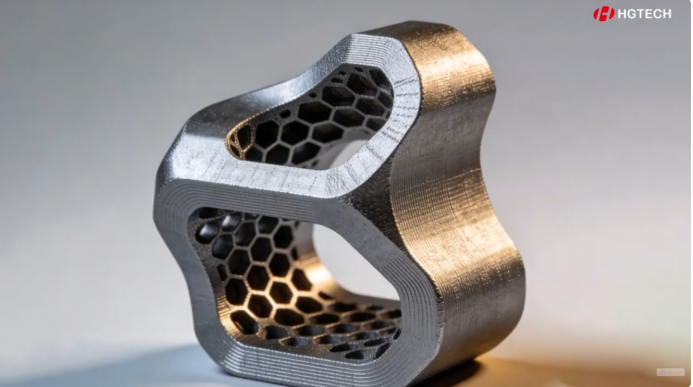
Nevertheless, innovative AI generated designs are constrained by conventional manufacturing processes. Subtractive manufacturing methods including turning, milling, planing and grinding are only suitable for simple and regular parts. Conventional processes struggle to produce complex inner cavities and monolithic hollow components created by AI. Parts have to be split and assembled, which brings complicated working procedures and low yield rates. Joint gaps and stress damage caused by assembly also degrade part performance. Numerous outstanding AI designs remain confined to drawings, resulting in an industrial gap marked by “advanced design yet lagging manufacturing”.
Upgrading additive manufacturing capacity holds the key to resolving this conflict. HGTECH independently developed the new generation industrial grade SLM laser 3D printing equipment, which adapts to the forming requirements of AI optimized topological structures and connects the full workflow from digital design to physical mass production.
Different from ordinary 3D printers, HGTECH leverages two self developed systems to address the long standing industry pain point of balancing precision and efficiency. Its self developed beam shaping system breaks the limitations of conventional fixed Gaussian beams. Adopting phased array optical technology, it dynamically adjusts spot profiles and energy distribution to fit diverse workpiece structures. It stabilizes the melt pool and minimizes defects such as pores and warpage. Parts achieve a density of up to 99.98%, dimensional accuracy of ±0.05 mm and CPK value above 1.33. It accurately reproduces thin wall, micro and intricate precision structures and meets stringent standards for aerospace and 3C electronics.
The self-developed 68 head multi beam collaborative system adopts division of labor for homologous coherent light and dynamic avoidance scanning. It supports large size powder bed coating and simultaneous processing of multiple parts, delivering a maximum forming efficiency of 800 cm³/h. Its efficiency is over 50 % higher than single laser equipment. It supports both prototype trial production and large-scale mass production, overturning the stereotype that 3D printing is only for sample making.
Supported by the two core technologies, the equipment has been deployed across multiple industries. In the 3C electronics sector, it mass produces special-shaped heat dissipation modules for AI servers. In aerospace, it realizes monolithic forming of lightweight components to eliminate assembly joints and extend component service life. For new energy vehicles, it manufactures automotive grade liquid cooled components and lightweight chassis parts. Compatible with titanium alloy, aluminum alloy, superalloy and other materials, the equipment serves scenarios including energy, medical care and scientific research.
AI expands the imaginative boundaries of design, while HGTECH laser 3D printing safeguards the solid manufacturing bottom line. With domestically controllable optical technologies, it fills the process gap between AI generated design and industrial implementation and empowers the upgrading of high end intelligent manufacturing.
Want to learn more? Contact us now!
 share
share


