
Automotive Industry
Laser Solutions for Automotive Manufacturing | HGLaser


 October 22, 2026
 14 Viewed
As demand for computing power continues to grow, large language model (LLM) training and AI computing centers are placing increasingly demanding requirements on server thermal management. While much attention is paid to chip and GPU performance, one critical factor is often overlooked:
Sustained computing performance depends on effective thermal management.
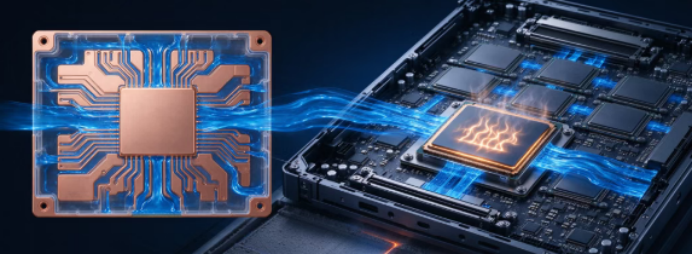
As the power consumption of AI servers continues to increase, high-density computing systems are placing greater demands on conventional air-cooling solutions. With its efficient heat transfer capabilities, liquid cooling is becoming an important solution for managing heat in high-power servers.
Metal 3D printing is opening up new possibilities for the design and manufacturing of microchannel liquid cooling plates for AI servers.
GPU power consumption in AI servers continues to rise, resulting in concentrated heat generation within high-density computing clusters. To maintain stable operation, minimize the impact of thermal constraints on computing performance, and extend hardware service life, efficient liquid cooling solutions are receiving increasing attention.
Microchannel cooling plates optimize internal flow channel structures to shorten heat transfer paths and improve heat exchange capacity per unit volume. Coolant flows through the internal channels of the cooling plate, carrying heat away through heat transfer between the heat source and the plate. This provides an efficient thermal management solution for high-power computing equipment.
However, conventional copper liquid cooling plate manufacturing typically involves machining, brazing, and assembly. These processes present challenges when producing and integrating complex microchannel structures, particularly for certain next-generation liquid cooling designs that require greater structural complexity and manufacturing integration.
Multiple machining and assembly steps: Individual channels may need to be machined separately before being assembled through brazing or other joining processes.
Potential risks at joints and interfaces: Multiple brazed seams and connection interfaces increase the complexity of sealing design and quality control.
Constraints on channel design: Manufacturing and integrating complex curved surfaces, variable cross-sections, and branching microchannels can be challenging.
Potential effects on heat transfer: Multi-component structures require careful consideration of contact thermal resistance and overall heat transfer paths.
Complex production workflows: Machining, joining, and assembling multiple components increase process management requirements and the complexity of production planning.
In response to these challenges, metal additive manufacturing offers an alternative approach to optimizing cooling plate structures and enabling integrated manufacturing.
Selective Laser Melting (SLM) is a metal additive manufacturing technology that uses a laser to selectively melt metal powder layer by layer. It enables the production of metal components with complex internal structures based on design requirements, supporting the development of integrated microchannel liquid cooling plates.
Compared with conventional manufacturing methods involving separate components and joining processes, SLM offers distinct advantages in complex channel design and component integration.
✔ Greater Design Flexibility: Supports the design and manufacturing of complex curved channels, variable cross-sections, and branching microchannels, expanding the possibilities for optimizing internal cooling plate structures.
✔ Fewer Brazed Joints: Integrated manufacturing can reduce brazed seams and related connection interfaces, helping lower potential leakage risks. Actual sealing performance still needs to be verified based on component design, build quality, and inspection results.
✔ Optimized Heat Exchange Structures: Internal channel layouts and heat exchange structures can be optimized according to thermal management requirements. Computational fluid dynamics (CFD) simulations and performance testing can then be used to evaluate flow distribution, heat transfer capability, and thermal resistance.
✔ Reduced Assembly Complexity: Integrating multiple components into a single part can reduce the number of separate components and assembly steps, simplifying product structures and manufacturing workflows.
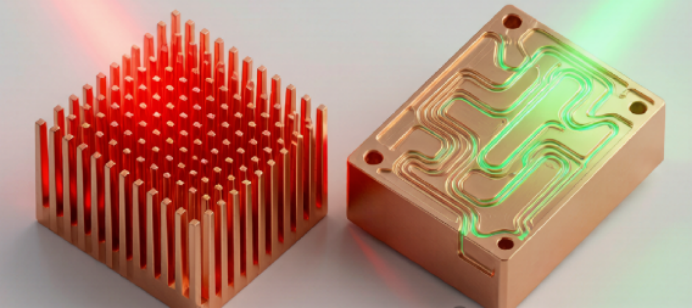
Copper offers excellent thermal conductivity. Combined with the ability of SLM to manufacture complex geometries, this material provides additional options for designing and developing high-performance microchannel liquid cooling plates. Actual cooling performance depends on material properties, channel design, build quality, and operating conditions.
To address the manufacturing requirements of copper components for AI liquid cooling applications, HGLaser leverages its LAM450 series precision SLM additive manufacturing equipment and copper material process development capabilities to support the development and production of complex metal components, including liquid cooling plates.
✔ Multi-Laser Processing: Coordinated multi-laser processing can improve production efficiency and support batch manufacturing of liquid cooling components. Actual productivity depends on component geometry, process parameters, and equipment configuration.
✔ Improved Build Quality: Through process parameter optimization, process control, and quality inspection, build quality can be improved, internal defects such as pores can be controlled, and batch consistency can be progressively enhanced.
✔ Processing of Copper and Other Highly Reflective Materials: Material and process adaptation addresses the high reflectivity of copper and the associated manufacturing challenges, helping improve process stability during printing.
✔ Comprehensive Metal Additive Manufacturing Solutions: Capabilities span structural design and simulation, material and process development, additive manufacturing, post-processing, and quality inspection, providing integrated support for the development and production of complex metal components.
As AI computing infrastructure continues to develop, liquid cooling components face increasingly demanding requirements for structural design, heat transfer performance, sealing reliability, and manufacturing consistency. With its ability to produce complex geometries and integrate multiple components, metal additive manufacturing offers new opportunities for design optimization and manufacturing innovation in advanced liquid cooling applications.
Building on its expertise in SLM metal additive manufacturing, HGLaser provides integrated capabilities for AI liquid cooling applications, including customized equipment development, material and process development, component process validation, and small- to medium-batch manufacturing services. These capabilities address manufacturing challenges such as thin-wall fabrication, precision dimensional control, and batch consistency, helping accelerate the development and validation of new AI liquid cooling components while supporting continuous process optimization.
 share


