
Automotive Industry
Laser Solutions for Automotive Manufacturing | HGLaser


 October 21, 2026
 7 Viewed
Shipbuilding laser welding is gaining attention as shipyards seek to improve welding productivity, control structural distortion, and reduce rework. From hull panels and stiffened plates to structural steel assemblies, welding quality directly affects dimensional accuracy, production schedules, and the reliability of ship structures. Conventional arc welding remains widely used, but large welded assemblies can require multiple passes, substantial heat input, and additional straightening, increasing labor requirements and production costs.

Laser welding uses a concentrated energy source to create localized welds, potentially enabling high welding speeds, deep penetration, and reduced heat input under suitable process conditions. These characteristics make it worth evaluating for repetitive seams and selected structural components. Laser-arc hybrid welding combines a laser beam with an arc process, offering an alternative for applications that require penetration capability and greater tolerance for joint gaps. Research on shipbuilding steel joints has demonstrated the potential of hybrid welding to achieve full penetration and reduce distortion under specific material, thickness, and joint conditions.
However, laser welding is not suitable for every shipbuilding application. Its effectiveness depends on material grade, plate thickness, joint design, fit-up accuracy, welding parameters, and production requirements. Selecting the right process requires balancing productivity with weld quality, dimensional accuracy, and the practical needs of shipyard operations.
Shipbuilding laser welding can be evaluated for applications such as flat-panel fabrication, hull plate joining, stiffened panels, and selected structural assemblies. Long weld seams and repetitive joints can accumulate distortion during production, making heat-input control and welding-sequence optimization important. By matching the welding process to the component geometry and production conditions, shipyards can assess opportunities to improve consistency and reduce corrective work.
Joint preparation is another critical consideration. Laser welding generally requires accurate alignment and consistent joint gaps, particularly when no additional arc process or filler material is used. Cutting accuracy, edge preparation, fixture design, and component positioning therefore influence process stability. For thicker plates or joints with greater fit-up variation, laser-arc hybrid welding may offer advantages because the arc can help bridge gaps and supply filler material.
Automation can further improve consistency in repetitive welding operations. Integrating welding equipment with motion systems, suitable fixtures, and process monitoring can reduce manual intervention and support more standardized production. Before implementation, manufacturers should evaluate material grades, plate thicknesses, joint configurations, accessibility, production volume, safety provisions, and applicable classification requirements. Representative welding trials are essential for validating penetration, weld geometry, mechanical properties, inspection results, and achievable productivity.
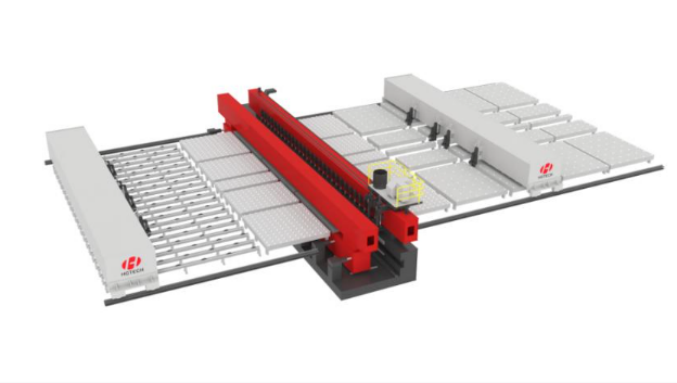
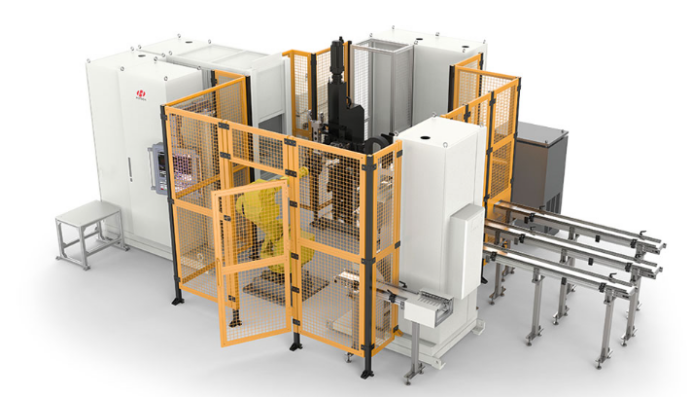
For shipyards considering laser welding automation, equipment selection should begin with the actual production challenge. Whether the priority is reducing distortion, increasing throughput, improving seam consistency, or automating repetitive joints, the proposed solution must match the materials, component dimensions, joint preparation, and quality standards involved.
HGLaser provides welding equipment and automation solutions for shipbuilding and marine engineering applications. Its portfolio includes laser-arc hybrid welding systems, teachless welding workstations, and automated fit-up and tack-welding workstations for small structural assemblies.
These solutions support applications such as hull plate joining, T-section fabrication, and pipe-to-pipe welding. According to the specified equipment capabilities, the solutions are designed to process materials including high-strength shipbuilding steel and aluminum alloys, with welding capabilities for medium-thick plates ranging from 5 to 50 mm.
Compared with some conventional welding processes, laser-arc hybrid welding can offer a smaller heat-affected zone, higher welding speeds, and improved process stability under suitable conditions. Welding efficiency may increase to two to three times the baseline level, depending on the application and operating parameters. AI-based visual positioning enables teachless welding workstations to identify and locate weld seams automatically, potentially reducing manual programming and supporting more consistent production.
HGLaser solutions can also be integrated with shipyard Manufacturing Operations Management (MOM) systems and digital twin systems, with interfaces to ship design software to improve data connectivity between design and production. Reported deployments include smart shipyard projects involving Jining Energy Xinneng Shipbuilding and China Merchants Industry Weihai Shipyard. Configurations can also support automated production lines for small structural assemblies and panel assembly and welding, helping improve production automation and quality traceability.
When evaluating shipbuilding laser welding equipment, manufacturers should consider process compatibility, achievable weld quality, integration requirements, operating costs, maintenance, and operator training. A practical starting point is to select a representative component, define measurable acceptance criteria, and compare the proposed process with the existing welding method.
Looking to improve welding productivity in your shipyard? Share your material grade, plate thickness, joint configuration, and current welding challenges with HGLaser. Our team can help evaluate suitable laser welding or laser-arc hybrid welding solutions for your application.
Explore our laser welding solutions or visit HGLaser to learn more about our industrial laser processing and automation capabilities.
 share


