
Automotive Industry
Laser Solutions for Automotive Manufacturing | HGLaser


 November 27, 2026
 8 Viewed
A BESS assembly line manufactures battery modules and packs for stationary energy storage. A typical line can combine automated loading, module assembly, busbar laser welding, visual inspection and electrical testing. The right configuration depends on what arrives at your factory and what needs to leave it. If your project starts with cells, the line may need incoming inspection and module assembly. If it starts with completed modules, the battery pack assembly line can focus on installing modules, making electrical connections, closing the enclosure and testing the finished pack.
For an automated BESS assembly line, the distinction matters when comparing layouts and quotations. A plant that already purchases tested modules may need pack integration and verification stations. A plant that produces its own modules must also plan for the upstream assembly and joining steps. The output of a module and pack BESS assembly line may feed a separate rack or container integration process. If your project includes that downstream work, define the handover at the outset, including the condition of the packs and the test records that travel with them. This gives suppliers a common scope for the quotation and makes it easier to see where equipment or testing responsibilities overlap.
On a BESS assembly line with in-house busbar welding, checking the joint after enclosure assembly makes defects harder to reach. It is practical to verify part position before welding and inspect the joint while it is accessible. A pre-weld vision inspection can check component position. Post-weld visual inspection can assess visible weld features, and a joint resistance measurement can help identify a high-resistance connection before pack closure. For a liquid-cooled pack, define which cooling connections are included in the leak test and at which assembly step it takes place.
Battery pack end-of-line testing on a BESS assembly line can include insulation resistance, dielectric withstand, battery management system (BMS) communication and contactor function, depending on the pack design and test plan. With manufacturing execution system (MES) integration, a BESS assembly line can associate test results with the module or pack serial number. If a pack fails an electrical check, a search by serial number can show which modules went into it, which station flagged the issue and whether the unit was retested. Routine production checks support release decisions. Where relevant to the project, UL 9540 addresses energy storage system and equipment safety, and UL 9540A evaluates thermal runaway fire propagation.
Start with the number of accepted packs a BESS assembly line must deliver per shift. For example, 80 accepted packs in 420 available production minutes means an average output interval of 5.25 minutes. An electrical test fixture occupied for eight minutes per pack cannot support that target on its own.
Additional fixtures may help if loading and shared test resources can keep pace. For a mixed-model BESS assembly line, evaluate changeover time as well. If different pack formats share the same stations, check whether a recipe change is sufficient or whether the operator also needs to replace fixtures. Compare proposals using the same panel of product formats and the same definition of an accepted unit. At the factory acceptance test for a BESS assembly line, agree on the run length, record good output and first-pass yield, and demonstrate one representative changeover. That gives the production team a basis for evaluating output beyond the cycle time of a single station.
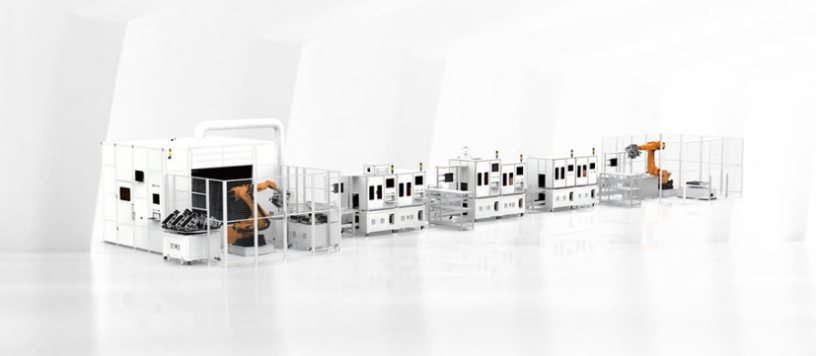
HGLaser’s automated BESS assembly line supports stationary energy storage battery manufacturing across multiple module formats, including modules built with pouch cells. The process covers automated module loading and assembly, side plate welding, cell terminal cleaning, pre-weld CCD vision inspection, busbar installation and laser welding, post-weld visual inspection, and module-level electrical performance testing. Automated guided vehicles (AGVs) transfer modules between operations, and the line handles finished module unloading. Each module receives a unique code that is scanned throughout the process and linked to its production data. MES integration and Internet of Things (IoT) connectivity make those data visible to production teams and support end-to-end product traceability. The BESS assembly line layout can be tailored to target output, cell specifications and available factory space. Robotic laser welding, vision-guided positioning and in-line inspection support consistent weld quality, production efficiency and operational safety controls. The line is designed for high-volume module production for commercial and industrial (C&I) and grid-side energy storage projects.
Planning a BESS assembly line for a new factory or an existing workshop? Share your cell or module specifications, target output, pack drawings and available floor space with HGLaser. Request a preliminary station layout and BESS assembly line proposal so you can review the assembly scope, testing capacity and product changeover requirements before finalizing the quotation.
HGLaser is a pioneer and leading enterprise in industrial laser applications in China, as well as a globally recognized provider of laser processing solutions.
We focus on the development of laser intelligent equipment, measurement and automation production lines, and smart factory solutions, delivering integrated systems for advanced intelligent manufacturing.
With a deep understanding of manufacturing industry trends, we continuously expand our product portfolio and solution capabilities. We are committed to the integration of automation, digitalization, intelligence, and manufacturing technologies, providing a wide range of industries with laser cutting systems, laser welding systems, laser marking equipment, laser texturing solutions, laser heat treatment systems, laser drilling machines, and supporting laser and plasma processing equipment.
In addition, we deliver complete solutions for special laser processing equipment, automated production lines, and smart factory construction.
 share


