
Automotive Industry
Laser Solutions for Automotive Manufacturing | HGLaser


 November 12, 2026
 16 Viewed
Hermetic welding of liquid cooling plates is a critical factor in the safety of liquid cooling systems. Three process routes are currently used across the industry: vacuum brazing (65%–68% market share), friction stir welding (25%–28%), and laser welding (5%–10%, with rapid growth). These processes differ significantly in equipment investment, energy consumption, unit cost, finished-product yield, structural compatibility, and production flexibility. Based on HGLaser’s 2026 liquid-cooling process test data, this issue provides a quantitative, multidimensional comparison and guidance on selecting the optimal process for different production volumes and product specifications.
| Comparison Item | Laser Welding | Vacuum Brazing | Friction Stir Welding |
|---|---|---|---|
| Current Market Share | 5%–10% | 65%–68% | 25%–28% |
| Weld Strength | ≥250 MPa | ≈200 MPa | ≈100 MPa |
| Finished-Product Yield | 99.99% | 92% | 99.99% |
| Flux / Filler Material | No brazing filler metal required | Aluminum / copper brazing filler metal; ongoing consumable cost | No consumables; tool-pin wear |
| Pre-weld Treatment | Simple degreasing | Pickling to remove oxides; complex process | Simple degreasing |
| Post-weld Treatment | Simple cleaning | Chemical cleaning, filler residue removal, and straightening | Finishing to remove tool marks |
| Automation and Flexibility | Very high; changeover in minutes | Very low; fixture changes take several days | Moderate |
| Compatible Structures | Compatible with flat, curved, and irregular geometries | Best for complex multilayer microchannel structures | Limited to simple flat plates |
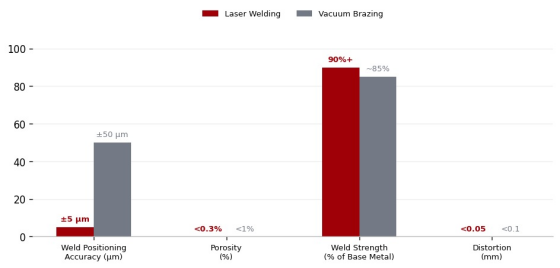
Weld Precision and Distortion Control: Laser welding positioning accuracy is ±5 μm, compared with ±50 μm for vacuum brazing. Distortion is <0.05 mm for laser welding and <0.1 mm for brazing. Porosity is <0.3% for laser welding and <1% for brazing. This micron-level control is well suited to thin-walled copper cold plates with 0.05 mm microchannels, without blocking the flow channels.
Welding Productivity: Laser welding speeds reach up to 500 mm/s, compared with only 50 mm/s for brazing. The laser welding time per weld point is ≤0.2 s, compared with 3–5 s for brazing. Overall production efficiency increases by 5–8 times. Dual-station equipment enables simultaneous loading, unloading, and welding, doubling equipment utilization.
Material Compatibility: Laser welding is highly compatible with aluminum, copper, stainless steel, and dissimilar-metal joints (such as copper-to-stainless-steel). Vacuum brazing is advantageous for complex, multilayer aluminum cold plates, but copper filler metal is very costly. Friction stir welding is limited to flat aluminum-alloy plates, with restrictions on dissimilar-metal joining.
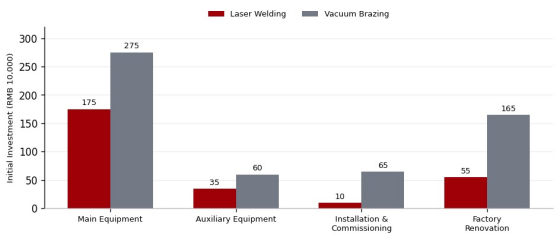
A complete laser welding system (main equipment, auxiliary equipment, and installation) costs RMB 750,000–3.65 million. Vacuum brazing equipment costs RMB 1 million–7 million. Vacuum brazing also requires a large, vibration-isolated facility and electrical infrastructure upgrades. Its power demand is 50–500 kW, compared with only 20–50 kW for laser welding.
Production Cost per Part: The Key Differences
Aluminum cold plates: approximately RMB 20 per part for laser welding, compared with RMB 28–35 for brazing.
Copper cold plates: approximately RMB 30 per part for laser welding, compared with more than RMB 40 for brazing. The cost difference comes from:
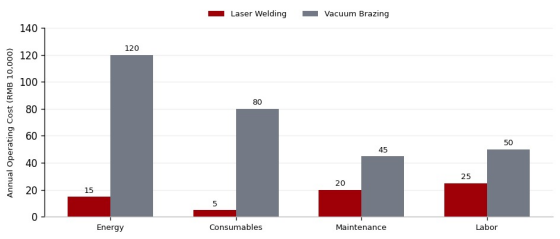
Energy consumption: Vacuum brazing furnaces require prolonged heat retention, resulting in electricity costs 15–25 times those of laser welding.
Filler metal: Brazing filler metal costs RMB 5–12 per copper cold plate; laser welding requires no brazing filler metal.
Pre- and post-processing: Brazing requires pickling, drying, and residue removal, increasing labor and chemical costs.
Scrap costs: The finished-product yield of vacuum brazing is only 92%, and scrap losses continue to erode margins.
Monthly output of 1,000–5,000 parts (small-to-medium batches, multiple specifications): Laser welding is preferred. Its unit cost is only 55%–70% of the brazing cost, and rapid changeovers support flexible, multi-product manufacturing.
Monthly output of 5,000–20,000 parts: Laser welding still offers a 65%–80% cost advantage.
Annual output of 2 million standardized, single-specification aluminum cold plates: Vacuum brazing benefits from economies of scale and has a slight cost advantage.
Copper cold plates, dissimilar-metal joints, and flexible lines handling multiple specifications: Laser welding has a lower cost across all production-volume ranges.
Laser welding has lower annual energy, consumables, maintenance, and labor costs than vacuum brazing. Its payback period is only 3–12 months. Vacuum brazing can reduce long-term operating costs through economies of scale only in very large, highly standardized production lines.
Vacuum brazing remains the mainstream process in existing production. However, for copper cold plates, flexible production lines handling multiple specifications, and applications driven by low-carbon and energy-efficiency requirements, laser welding is the preferred long-term upgrade path. In Episode 03 of HGLaser Tech Academy, we will examine three laser-specific solutions: blue-and-red hybrid lasers, ABP point-ring beam profiles, and green-laser SLM 3D printing, which address the major industry challenge of welding highly reflective copper materials.
 share


