
Automotive Industry
Laser Solutions for Automotive Manufacturing | HGLaser


 November 25, 2026
 40 Viewed
In the previous issue, we compared three liquid-cooling sealing processes—laser welding, vacuum brazing, and friction stir welding—and reached a key conclusion: laser welding offers significant cost and quality advantages for copper-based cold plates, dissimilar-metal joints, and flexible production lines handling multiple product types. However, the industry continues to face a major technical challenge: pure copper is highly reflective. Traditional 1070 nm infrared fiber lasers achieve an absorption rate of only 3%–5% on copper, making welding prone to spatter, porosity, lack of fusion, and insufficient penetration.
Building on four technical approaches—450 nm blue lasers, 532 nm green lasers, ABP core-ring beam shaping, and green-laser SLM metal additive manufacturing—HGLaser has developed a tiered solution portfolio covering thin copper sheets, thick copper plates, aluminum alloys, and ultra-high-density topological microchannel cold plates. Starting with the optical properties of materials, this issue explains how to match laser sources to applications, along with equipment configurations, welding results, and practical selection criteria.
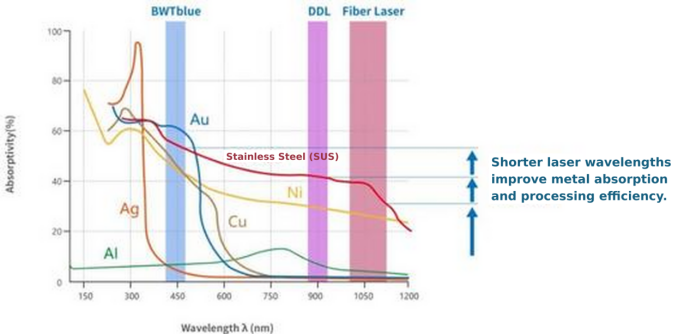
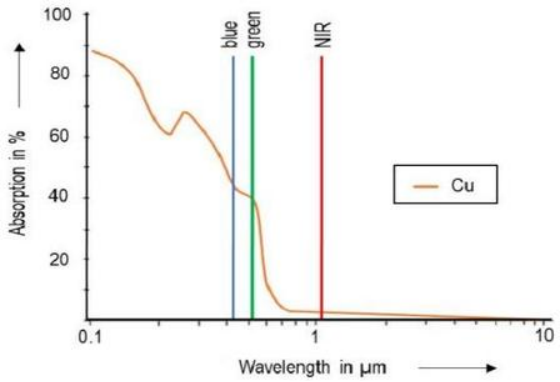
1.1070 nm infrared fiber laser: Pure copper absorptivity is only 3%–5%. Most of the energy is reflected and lost, making the molten pool unstable and causing severe spatter, blowouts, and lack of fusion at the weld start.
2.450 nm blue laser: Pure copper absorptivity reaches 60%–65%, substantially increasing initial energy absorption and stabilizing the molten pool.
3.532 nm green laser: Pure copper absorptivity is approximately 37%, making it suitable for precision sealing of ultra-thin copper foil measuring 0.06–0.15 mm.
4.915/980 nm semiconductor infrared laser: Slightly improves aluminum-alloy absorptivity and can be combined with a wobble process to suppress cracking.
Three inherent challenges in pure copper welding:
① High reflectivity: most laser energy is reflected, resulting in very low energy utilization.
② High thermal conductivity: heat dissipates rapidly, making it difficult to form a stable deep-penetration weld pool.
③ Significant heat absorption during phase changes: metal vapor impact can occur, leading to porosity and spatter.
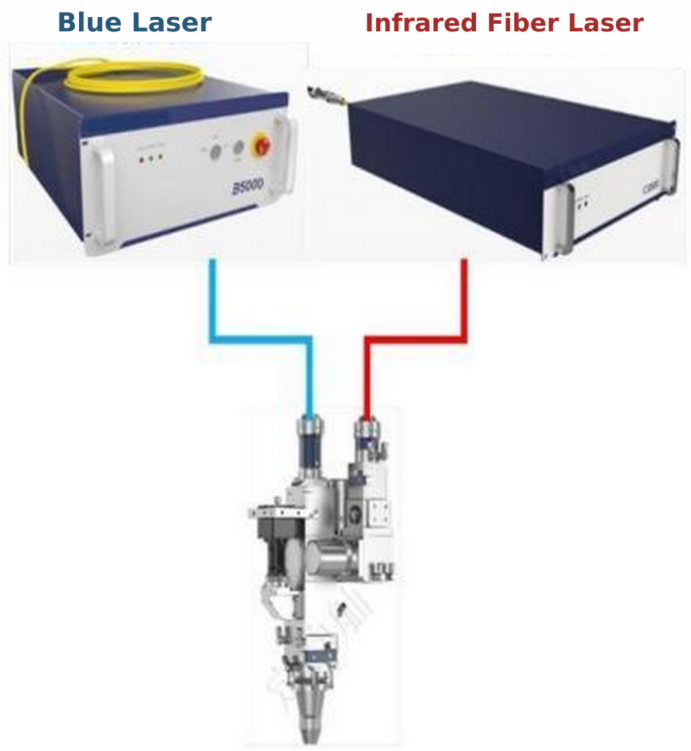
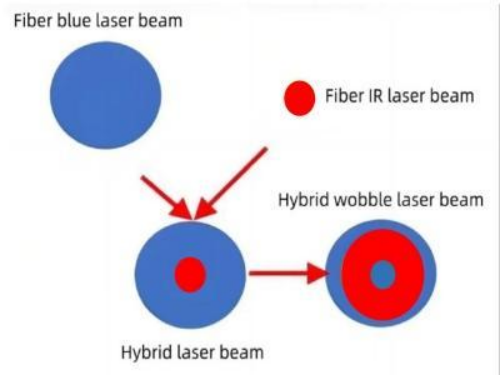
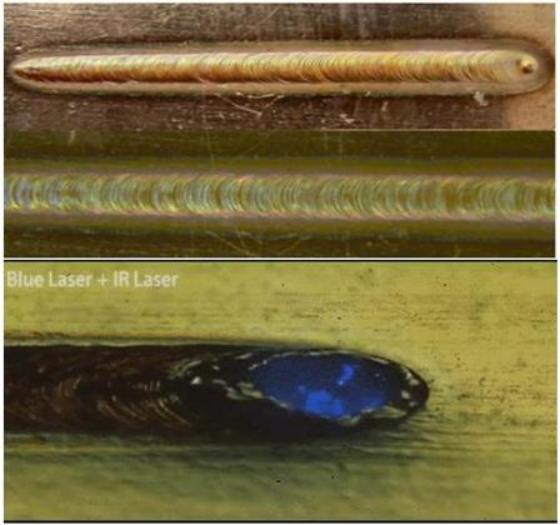
Two independent laser sources are coupled into a single wobble welding head:
1.Addresses spatter, blowouts, and porosity in thick copper plates (>1 mm). The weld is free of impurities, keeping flow channels clean and unobstructed.
2.Compatible with dissimilar metals: enables stable metallurgical bonding of pure copper to stainless steel, copper to aluminum alloy, and aluminum to stainless steel.
3.Weld penetration can exceed 2.8 mm, and the weld can pass a 100% helium/leak-tightness test on the first attempt.
4.No filler metal or pickling is required before or after welding. Energy consumption per part is only 1/20 that of vacuum brazing.
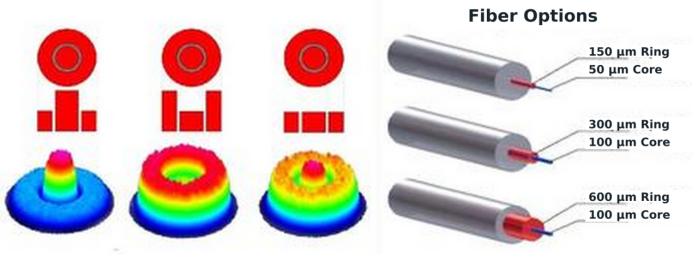
A single fiber laser outputs two independently controllable beams: a central core beam and an outer ring beam.
A conventional single Gaussian beam has an excessively high energy peak at its center, causing localized metal vaporization. Vapor pressure disperses the molten metal and generates substantial spatter. The ABP outer ring uniformly preheats the workpiece and flattens the energy peak, stabilizing molten-pool dynamics and reducing spatter by more than 90%.
1.Large-scale production of aluminum-alloy cold plates for liquid-cooling systems.
2.Sealing welds for aluminum busbars in AI racks, battery connectors, and prismatic aluminum housings.
3.Rapid changeovers on flexible, multi-product production lines without changing fixtures; program switching takes only a few minutes.
4.Welding of lightweight aluminum manifolds and corrugated-pipe connectors.
Wavelength: 510–550 nm; continuous-wave output: 500 W; copper absorptivity: 37%. Developed for ultra-thin copper sheets measuring 0.06–0.15 mm. The lower substrate must not be penetrated during welding; penetration depth is precisely controlled at 0.05–0.10 mm. Vacuum leak testing must show no leakage at <6 Pa.
| Metric | 1080 nm Infrared Laser | 532 nm Green Laser |
|---|---|---|
| Power | 225 W | 200 W |
| Welding Speed | 200 mm/s | 300 mm/s |
| Linear Energy Density | 1.13 J/mm | 0.67 J/mm |
| Weld Defects | Significant spatter and blowouts | Smooth weld surface, with no spatter or porosity |
Ultra-thin vapor chambers (VCs), microchannel copper cold plates for compact AI computing modules, and copper-foil sealing components for small chip-cooling devices.
Skived-fin plus brazed cold plates and laser-welded cold plates are both assembled from multiple components, creating interfacial thermal resistance. Complex biomimetic and lattice-topology microchannels cannot be manufactured using these methods, limiting maximum heat flux and making it difficult to meet the cooling requirements of high-computing-power chips exceeding 1,000 W/cm².
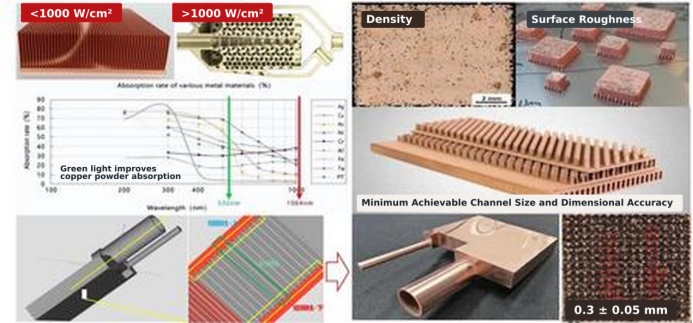
1.The 532 nm green laser addresses the high reflectivity of pure copper powder. Copper density reaches ≥99.6%, with surface roughness Ra ≤3 μm.
2.Minimum microchannel wall thickness is ≤0.05 mm. Topological lattice structures are formed in one piece without joining welds, eliminating coolant leakage and interfacial thermal resistance.
3.At the same heat-dissipation power, structural weight is reduced by 50%, while heat-exchange efficiency increases by 40%.
4.AI vision-based powder-spreading monitoring keeps dimensional deviation within ≤0.05 mm during long-duration builds.
Advanced supercomputing; two-phase liquid-cooling cold plates for high-power VR300 GPUs rated at 3,600 W per card; customized, small-batch, high-performance thermal components; and rapid iterative validation of thermal-management structures in advanced laboratories.
```
| Workpiece Material & Specification | Recommended Laser Solution | Key Benefits |
|---|---|---|
| Aluminum-alloy cold plates and aluminum manifolds | ABP core-ring beam fiber laser | Low mass-production cost, fast changeovers, no spatter |
| Pure copper cold plates >1 mm thick; copper-to-stainless-steel dissimilar-metal joints |
Red-blue hybrid wobble laser | Deep penetration, 100% leak-tightness, suitable for thick copper |
| Ultra-thin copper foil (0.06 – 0.15 mm) and VC vapor chambers | 532 nm continuous-wave green laser | Precisely controlled shallow penetration, no burn-through or blowouts |
| Ultra-high-density topological microchannels and advanced two-phase cold plates | Green-laser SLM 3D printing |
One-piece structure without weld seams; pushes the limits of heat dissipation |
The industry's bottleneck in highly reflective copper welding can be addressed through three technology paths: short-wavelength laser sources, beam shaping, and additive manufacturing. For high-volume aluminum cold plates, choose ABP core-ring beam shaping; for thick copper and dissimilar-metal joints, choose red-blue hybrid welding; for ultra-thin copper foil, use green-laser welding; and for extreme heat-dissipation requirements, use integrated green-laser SLM printing. The next issue, 【HGLaser Tech Academy | Issue 04】, will focus on end-to-end quality control in intelligent liquid-cooling manufacturing: vision-based positioning and correction before welding, in-process OCT penetration monitoring, post-weld AI vision inspection, and picosecond-laser serialization for full-lifecycle traceability. We will provide a complete breakdown of the quality-control system for intelligent laser manufacturing.
 share


